As a supplier of AC Resistive Reactive Load Banks, I often encounter various technical inquiries from our clients. One frequently asked question is: Can an AC Resistive Reactive Load Bank be used in series? This question delves into the technical nuances of load banks and has significant implications for different applications. In this blog post, I’ll explore this topic in depth, discussing the feasibility, advantages, challenges, and considerations when using AC Resistive Reactive Load Banks in series. AC Resistive Reactive Load Bank

Understanding AC Resistive Reactive Load Banks
Before we dive into the series connection aspect, it’s essential to understand what AC Resistive Reactive Load Banks are. These load banks are specialized devices used to simulate real – world electrical loads. They consist of resistive and reactive components. The resistive part dissipates electrical energy as heat, similar to how a heater works. The reactive component, on the other hand, stores and releases energy in the form of an electromagnetic field, which is crucial for testing electrical systems that deal with inductive or capacitive loads, such as generators, UPS (Uninterruptible Power Supply) systems, and transformers.
Feasibility of Using AC Resistive Reactive Load Banks in Series
The short answer is yes, an AC Resistive Reactive Load Bank can be used in series. However, there are several factors to consider.
Voltage and Current Distribution
When load banks are connected in series, the total voltage across the combination is divided among the individual load banks. The current flowing through each load bank is the same. This means that if the load banks are rated for different voltages, careful consideration must be given to ensure that each load bank operates within its voltage limits. For example, if we have two load banks, one rated for 200V and the other for 400V, and they are connected in series across a 600V source, the voltage distribution must be calculated accurately. If the impedance of the load banks is known, we can use Ohm’s law (V = IR) to determine the voltage across each load bank.
Power Rating
The total power rating of load banks connected in series is not simply the sum of their individual power ratings. The power dissipated in each load bank is calculated based on the current flowing through it and the voltage across it (P = VI). When connected in series, the current is the same through all load banks, but the voltage is divided. Therefore, the power dissipated in each load bank will depend on its impedance and the overall circuit conditions.
Advantages of Series Connection
Higher Voltage Testing
One of the main advantages of connecting AC Resistive Reactive Load Banks in series is the ability to test electrical systems at higher voltages. If a single load bank has a limited voltage rating, connecting multiple load banks in series can increase the overall voltage that the combination can handle. This is particularly useful for testing high – voltage generators or transformers.
Incremental Load Testing
Series connection also allows for incremental load testing. You can start with one load bank and add more load banks in series as needed to gradually increase the load on the electrical system under test. This is beneficial for accurately assessing the performance of the system under different load conditions.
Challenges and Considerations
Impedance Matching
For proper operation of load banks connected in series, impedance matching is crucial. If the impedances of the load banks are not properly matched, the voltage distribution across the load banks may be uneven, leading to overvoltage or undervoltage conditions in some of the load banks. This can cause damage to the load banks or inaccurate test results.
Thermal Management
When load banks are connected in series, the heat generated by each load bank must be managed effectively. Since the current is the same through all load banks, the power dissipation and heat generation in each load bank depend on its impedance. Adequate ventilation and cooling systems must be in place to prevent overheating, which can reduce the lifespan of the load banks and affect their performance.
Control and Monitoring
Series – connected load banks require more sophisticated control and monitoring systems. Each load bank must be monitored for voltage, current, and temperature to ensure safe and proper operation. In addition, the control system needs to be able to adjust the load on each load bank to maintain the desired overall load characteristics.
Applications Where Series Connection Can Be Beneficial
High – Voltage Generator Testing
In the power generation industry, high – voltage generators need to be tested under various load conditions. Series – connected load banks can be used to simulate high – voltage loads, allowing for accurate testing of the generator’s performance at different output voltages and power levels.
Transformer Testing
Transformers are often tested to ensure their efficiency and performance. By connecting load banks in series, it is possible to create a more complex load profile that closely mimics the real – world operating conditions of the transformer. This helps in identifying any issues with the transformer’s voltage regulation, efficiency, and load – carrying capacity.
Pre – installation Checks
Before connecting AC Resistive Reactive Load Banks in series, several pre – installation checks should be carried out. These include:
- Electrical Rating Verification: Ensure that the combined electrical rating of the load banks (voltage, current, and power) is compatible with the source and the system under test.
- Physical Inspection: Check for any physical damage to the load banks, such as loose connections, damaged components, or signs of corrosion.
- Functionality Testing: Test each load bank individually to ensure that it is functioning properly and that all control and monitoring features are working as expected.
Technical Support and Troubleshooting
As a supplier, we offer comprehensive technical support to our customers who are considering using AC Resistive Reactive Load Banks in series. Our team of experts can assist with installation, commissioning, and troubleshooting. We can also provide training on how to operate and maintain the load banks safely and effectively.
In case of any issues, our troubleshooting process involves a systematic approach. First, we analyze the system configuration to ensure that all connections are correct. Then, we use diagnostic tools to measure the voltage, current, and power at different points in the circuit. Based on these measurements, we can identify the root cause of the problem and provide solutions.
Conclusion
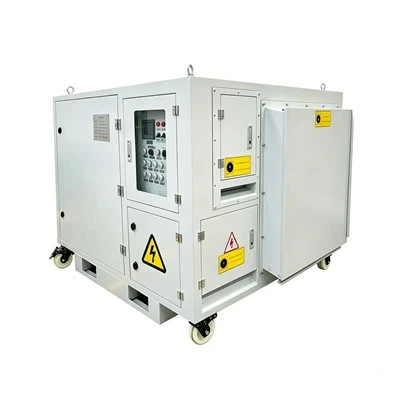
In conclusion, using an AC Resistive Reactive Load Bank in series is technically feasible and offers several advantages, such as higher voltage testing and incremental load testing. However, it also comes with challenges, such as impedance matching, thermal management, and control and monitoring. As a supplier, we understand the complexities involved in series – connecting load banks and are committed to providing our customers with the best products and support.
High Voltage Load Bank If you are interested in purchasing AC Resistive Reactive Load Banks for your specific application or need more information on series connection, please feel free to contact us for a detailed discussion. We look forward to helping you find the right solution for your electrical testing needs.
References
- Electrical Engineering Handbook, Third Edition, CRC Press
- Power System Analysis and Design, Fifth Edition, Cengage Learning
- Load Bank User Manuals provided by leading manufacturers
Hebei Kaixiang Electrical Technology Co., Ltd.
Hebei Kaixiang Electrical Technology Co., Ltd. is one of the most professional ac resistive reactive load bank manufacturers and suppliers in China, featured by quality products and good price. Please rest assured to wholesale advanced ac resistive reactive load bank for sale here and get quotation from our factory. We also accept customized orders.
Address: No79 Wangshan Road,Luquan District, Shijiazhuang, Hebei, China
E-mail: triumphload@kxload.com
WebSite: https://www.triumphload.com/
